I run the buyer's chair at a club with 400 members in Naples, Florida, which means I spend more time than I'd like talking people out of $250 paddles they saw in a video. When a new member asks me about pickleball paddles for beginners, the conversation always starts in the same place: they've picked a model, they want permission, and what they usually need is a cheaper paddle plus a few lessons. This comparison covers four paddles that come up in that conversation again and again. One is a wood set of four that costs less than dinner for two. Two are carbon fiber paddles sitting in the same price band as each other. The fourth is a lightweight JOOLA built for exactly the player asking me the question.
For a household, a foursome, or a club loaner bin, the wood set of four is the honest answer. For one player who will be on court twice a week, the JOOLA Astral Perseus is the paddle I'd hand a 55-year-old recreational player. The two carbon fiber options in the middle are worth trying if you want more face than wood and you're buying for two people at once.
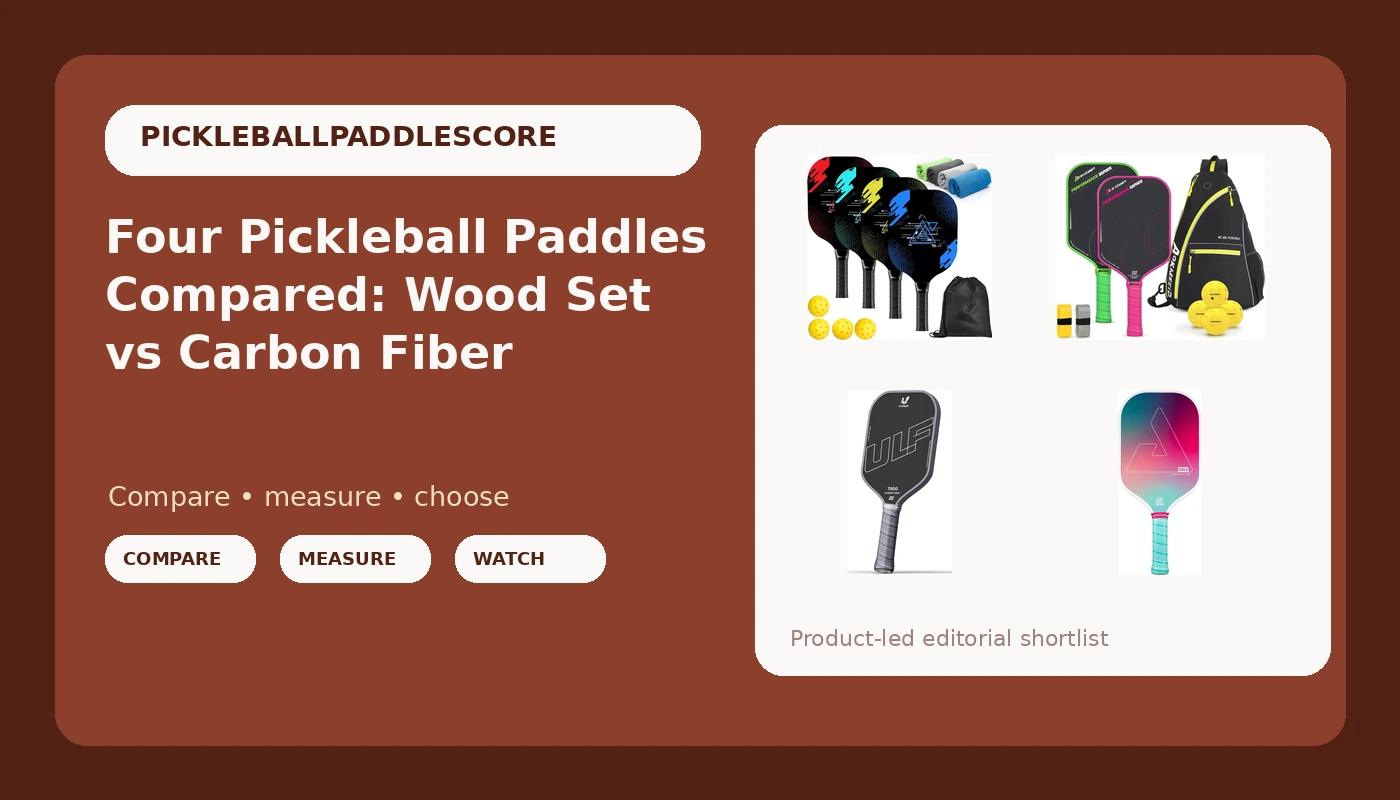
Pickleball Paddles Set of 4, Wood Set with Comfort Grip
Four paddles, four balls, four cooling towels and a carry bag in one box, which is the cheapest way to get a family or a foursome onto a court
Wood construction, no grit face, and grips that will not survive a Naples summer
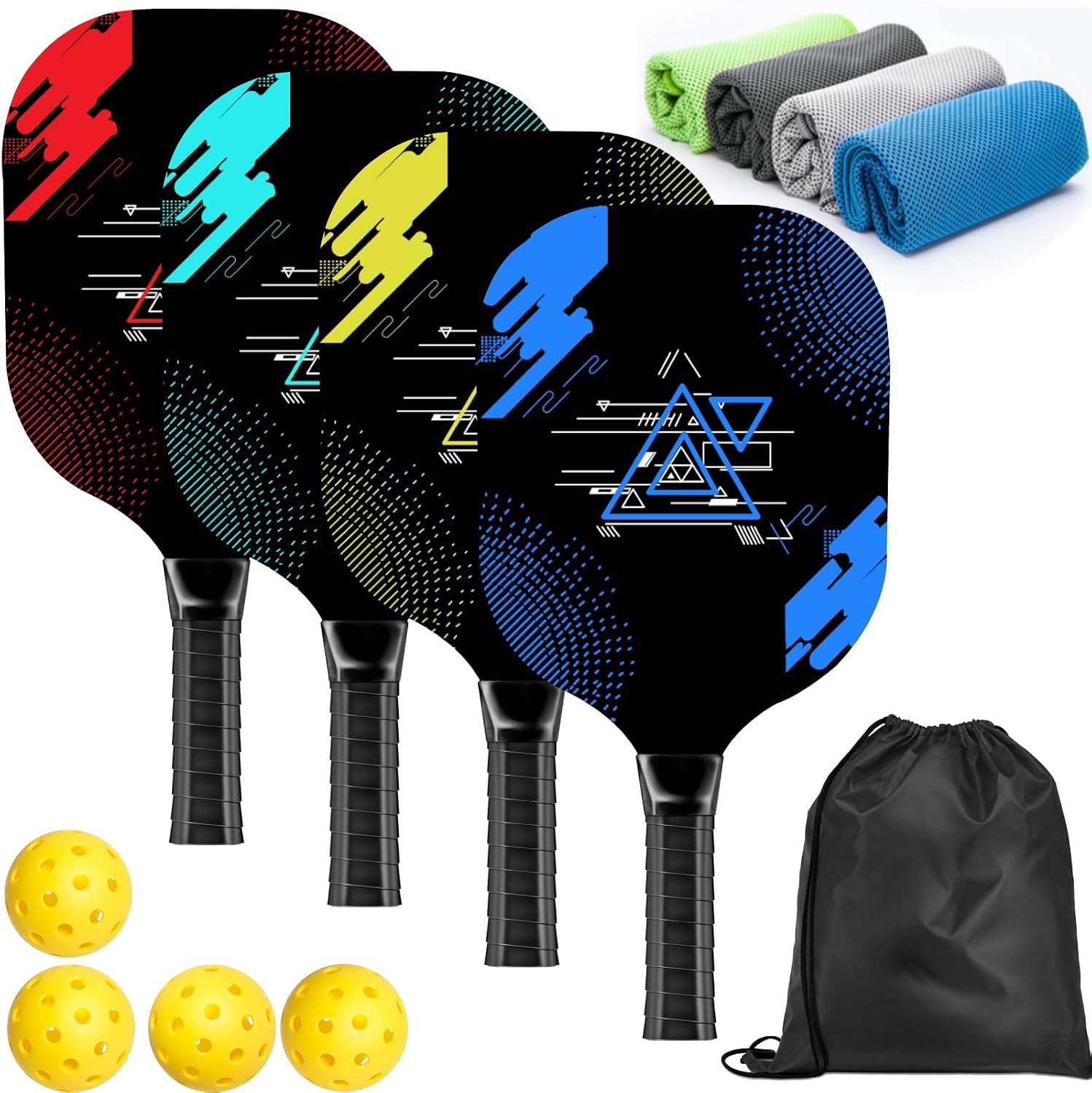
Sport AKS Carbon Fiber Pickleball Paddle Set, USAP Approved
Carbon fiber face and stated USAP approval in a set, so two players move off wood at the same time
You pay for more than one paddle whether you need it or not, and a set makes it harder to fit one paddle to one player
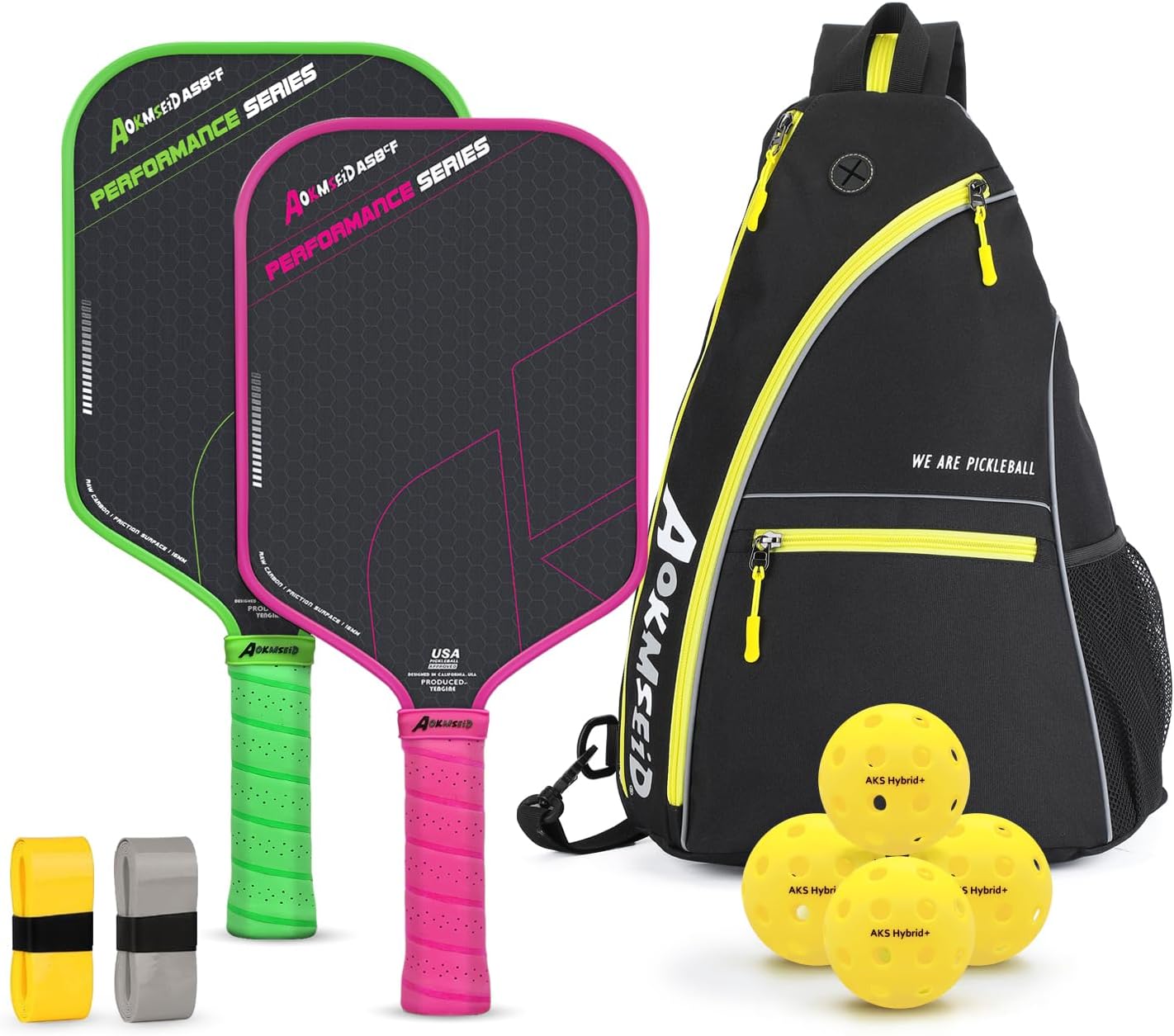
UNILEAF Pickleball Paddle, T800 Carbon Fiber
A T800 carbon fiber face with a stated 6-month warranty, the most concrete durability promise in this group
No USA Pickleball approval in the name, and a warranty covers defects, not a face texture that wears smooth
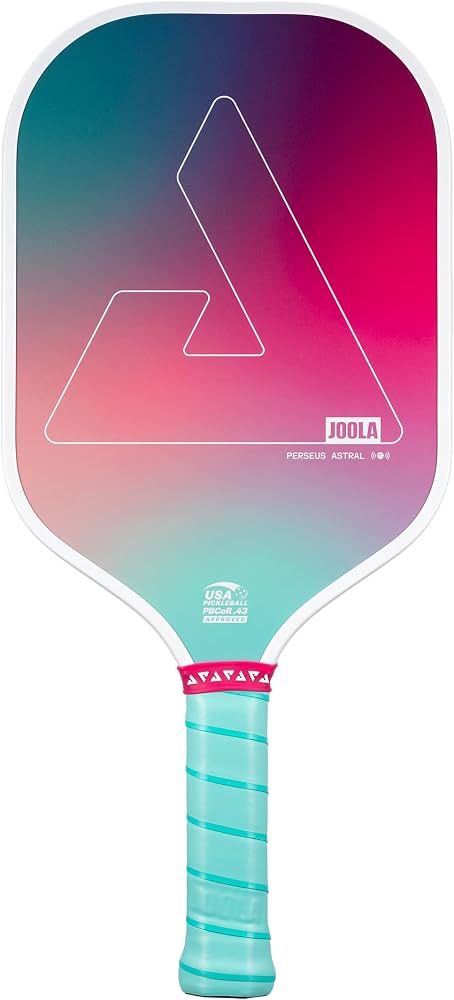
JOOLA Astral Perseus Pickleball Paddle, Beginner Friendly Lightweight
Lightweight build, sandblasted carbon fiber face for spin and control, moisture-wicking grip, USA Pickleball approved
Beginner-friendly means less power as you improve, and the NFC chip is a feature you will forget you have
Prices and availability were captured from Amazon Creators API and may change.
What actually separates these four paddles
Strip away the marketing and four things decide whether you enjoy a paddle: the face material, the size of the sweet spot, the grip, and whether the thing is still playable in three months.
Face material is the first fork. Wood is the traditional entry point and it is not a scam, but a wood face has no grit and no give, so spin has to come entirely from your hand. Carbon fiber gives you a stiffer face with a textured surface that grabs the ball. Two of these four are carbon fiber, one is T800 carbon fiber, and one is wood.
The second fork is single versus set. Two of these products are sold as sets, which changes the math completely. A set is a great deal for a couple or a family and a bad deal for one person who only needs one paddle.
The third thing I look for is the technology story, and here is the honest version: thermoformed construction is the only real leap in paddle building over the last three years, and none of these four leads with it. That tells you where they sit in the market. These are recreational paddles, and for most of the people reading this, that is exactly right.
The wood set of four: the right first paddle for a group
The Pickleball Paddles Set of 4, Wood Pickleball Set with Comfort Grip is the one I recommend to the member who says "my kids are visiting for a week and I want to try this." Four paddles, four balls, four cooling towels, and a carry bag. Nobody in that scenario needs a $200 paddle, and buying four of anything else means you have spent real money before you know whether you like the sport.
What you give up is everything a carbon face does for you. Wood is heavier in the hand, the sweet spot is smaller, and there is no textured surface, so the ball comes off flat. On a slow third shot, that is fine. On a fast exchange at the kitchen line, a wood paddle will feel like a plank, because it is one.
My specific warning is the grip. Cheap grips in Florida humidity turn slick and then start to unravel, and a paddle that twists in your hand is how wrists get sore. If you buy this set, budget for replacement grip tape, or wear a glove. Treat it as a loaner set you keep in the car for guests and it will serve you for years.
Sport AKS carbon fiber: the set that upgrades two players at once
The Sport AKS Carbon Fiber Pickleball Paddle Set is aimed at the couple who have been sharing one wood paddle and fighting over it. Carbon fiber face, USAP approved, sold as a pair. If two of you are playing twice a week, the per-player cost lands in the range I actually recommend to recreational players, and you both move up at the same time.
The trade-off is fit. A set is one design, one weight, one grip size, and two people with different hands and different games are now stuck with the same paddle. If one of you is a banger and the other is a dinker, one of you is going to be unhappy.
The USAP approval claim matters more than most buyers realize. If you ever want to play a sanctioned tournament, the paddle has to be on the approved list, and I have seen paddles arrive with approval language on the box that did not match the list. Check the current USA Pickleball approved paddle list against the exact model before you buy, not after you've entered a tournament.
UNILEAF T800: the warranty is the interesting part
The UNILEAF Pickleball Paddle, T800 Carbon Fiber is a single paddle with a T800 carbon fiber face and a stated 6-month warranty. T800 is a grade of carbon fiber, and it tells you the face is a real carbon weave rather than a cosmetic layer.
The warranty is what I'd focus on. Six months is short by the standards of a paddle that should last a couple of seasons, but it is a written commitment, and most paddles at this price come with nothing at all. Read what it covers before you rely on it. A warranty almost never covers a face texture wearing smooth from play, which is the failure mode that actually ends a paddle's life. It covers defects, and defects are rare. Wear is guaranteed.
What I'd want to know before recommending this one to a club member is the grip circumference and the actual weight in the hand, because T800 is a face spec, not a weight spec. Ask the seller, or buy from a listing with a real return window.
JOOLA Astral Perseus: the beginner-friendly pick
The JOOLA Astral Perseus Pickleball Paddle is the one I'd hand to a 55-year-old recreational player without hesitation. It is built lightweight, which matters more than any other single number for a player whose shoulder is 30 years past college tennis. It has a carbon fiber sandblasted surface for spin and control, a moisture-wicking grip, and USA Pickleball approval.
The sandblasted face is the piece that separates it from the wood set and from a smooth composite face. Grit gives you spin without changing your stroke. My standing line on spin is that it is 30% paddle and 70% technique, so a textured face is a multiplier on skill you already have, not a substitute for it. If you can't generate spin with a smooth paddle, a sandblasted one won't fix that. If you can, this face rewards you.
The moisture-wicking grip is the quiet win. I have watched more club members lose points to a slippery grip in August than to any paddle deficiency. If you sweat, this is the feature to care about.
The NFC chip is a novelty. It is a nice registration trick and it will not change a single shot. Do not let it move the paddle up your list.
The honest limit of this paddle is the word "beginner" in its own description. Lightweight and forgiving means less mass behind the ball. As your game sharpens and you start driving the ball, you will feel that. That is not a defect, it is a trade, and it is the correct trade for the player it's aimed at.
Spin, grit faces, and the humidity problem
Every textured face wears. Sandblasted carbon, raw carbon, and painted grit all lose bite as the surface polishes, and the timeline depends on how often you play and how much you hit the ball. A player on court three times a week can feel a grit face soften within a few months. This is why I care about face texture claims, and it is why I distrust any paddle marketed on spin alone.
Wood has the opposite problem: no texture to lose, but no texture to begin with.
If spin is your priority, clean your paddle face with a soft damp cloth and skip the abrasive cleaners. And keep your expectations calibrated. The best spin paddle in the world will not outperform clean contact and a low-to-high swing path.
Sweet spot beats raw power for most players
Nine out of ten players I coach would improve more from a bigger sweet spot than from more power. Power you can't control is just a faster way to lose the point.
Wood has the smallest sweet spot of anything in this comparison, which is why mis-hits die off the paddle. Carbon fiber faces, and especially lightweight wide-body designs like the JOOLA, forgive contact that is off center. That forgiveness shows up in the score, not in the spec sheet.
If you are choosing between a powerful paddle you can only hit cleanly twice a set and a forgiving paddle you can hit cleanly all night, take the forgiving one. Buy power later, when your hands are good enough to use it.
What I watch for at the three-month mark
I keep a log on every paddle that comes through my club, and the pattern is boring and consistent. Edges chip first. Then the face texture fades. Then the grip goes. A paddle that feels incredible in week one and dead by week six is a failed product no matter how it plays fresh, and I have seen plenty of expensive paddles fail that test.
The practical version for a buyer: check for an edge guard that is flush rather than proud, because a raised guard catches the ball on low resets. Expect to replace grip tape on any paddle you play with twice a week in Florida. And if you are hard on equipment, buy from a listing with a return window and a stated warranty, which is the one place the UNILEAF paddle earns a point.
What I'd actually tell you to buy
If you are outfitting a group, a family, or a guest bin, buy the wood set of four and put the savings toward a lesson. If you are one player who will be on court twice a week and you want a paddle that helps you rather than punishes you, buy the JOOLA Astral Perseus. If two of you are upgrading from wood together, the Sport AKS carbon fiber set is the efficient move. And if a stated warranty is what makes you comfortable spending money, the UNILEAF T800 is the one to look at.
The $80 to $150 band is the sweet spot in this sport. Below it you get dead cores and slick grips. Above it you are paying for pro sponsorships and a paint job. All four of these paddles sit at or under that band, and for the players reading this, that is where you want to be.
What I'm watching next
Thermoformed construction will be standard at every price point within two years, and when it is, the marketing will move on to core materials. Watch the used market for the 2025 hype paddles selling at half price. What holds its value tells you what actually held up.
In the meantime, my advice does not change. Mid-price, durable, big sweet spot. The recreational majority keeps winning with exactly that.